TYPING GUIDE
Small Word Typing Practice: Articles and Connecting Words
Practise a, the, to, from and other small words with three copying exercises, two original passages and a sentence-by-sentence review routine.
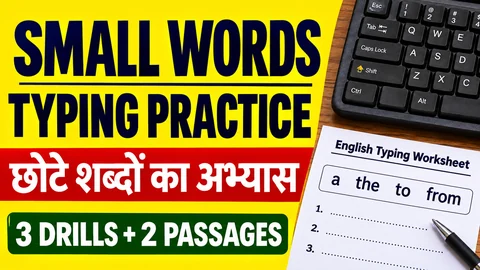
Small words are easy to overlook when copying a sentence. You may type a long noun correctly but leave out a, the, to or of. The sentence may still look familiar, which makes the omission harder to notice during a quick check. This worksheet focuses on those short connecting words rather than isolated spelling practice.
The examples below are original learning material with fictional college and community settings. They are not official examination passages. Use them for careful copying and comparison; they do not establish an exam score or guarantee a particular speed.
Prepare the reference
Open the English typing practice tool, choose your own paragraph and place one exercise in the setup box. Apply it with Use this paragraph. Include only the exercise text, without its heading or explanation. Type the answer yourself in the separate test area, where pasting is blocked.
Keep your correction setting the same when comparing attempts. A short exercise can finish when you reach the reference length, before the selected duration expires. Record whether the text finished or time ran out. A completed short reference does not show that you maintained the same pace for five minutes.
Exercise 1: Keep a and the visible
A student placed a folder on the table. The student opened the folder and checked a note inside it. A volunteer moved the table nearer the window.
Before typing, find every a and the in the reference. After typing, compare them in sentence order. Do not change a folder to the folder because that seems more natural to you. Exact copying means preserving the given wording, including the capital A at the start of a sentence.
For this exercise, there are four standalone instances of a or A and five instances of the or The. These counts are a checking aid, not the site's scoring formula. Matching the totals alone is insufficient: the words must also appear in the correct positions.
Exercise 2: Follow to, from and for
The clerk took the form from the tray and passed it to the visitor. The visitor asked for a pen before returning the form to the clerk.
Check the direction of each phrase instead of guessing from context. From the tray, to the visitor and for a pen have different jobs in the sentence. Your task is to copy their letters and spaces exactly. If you replace one short word with another, describe that as a substitution in your review note.
This reference contains two instances of to, one of from and one of for. If your totals differ, compare the original sentence again to locate the mismatch. Do not insert a word at the end just to make the count agree.
Exercise 3: Read both sides of and
The teacher checked the register and the timetable. The assistant collected the notebooks and the worksheets. The volunteer closed the cupboard and returned the key.
Each and connects two parts of a sentence. Read the word immediately after it before you continue typing. Notice that the first two sentences repeat the after and, while the final sentence continues with returned. A repeated sentence pattern can encourage you to add a word that the reference does not contain.
Passage 1: The notice board
A student stopped at the notice board near the college library. The board held a timetable for the reading group and a note about the next meeting. She copied the time into her notebook before returning to the classroom. At the door, another student asked for a copy of the note. They checked the board together so that neither had to rely on memory. The teacher later asked the group to read the complete instruction before choosing a place to sit. A short discussion helped the students understand which materials were for individual work and which were for the whole group.
Passage 2: The community cupboard
The volunteer opened the cupboard at the community centre and checked the materials on the lower shelf. A box of pencils stood beside a packet of paper. The organiser asked for a small bundle of sheets for the afternoon activity. Before carrying the bundle to the front room, the volunteer counted the sheets and put the packet back on the shelf. A second volunteer brought a tray for the pencils. They left the cupboard clear of loose paper so that the next group could find the materials without moving everything. At the end of the session, both volunteers returned the unused supplies to their places.
Compare in short sections
After an attempt, compare one sentence at a time. Start with the opening words, then move through each space to the next word. Check short words even when the sentence already seems to have the right meaning. In Passage 2, for example, a box of pencils should not become a box pencils.
Write one exact mismatch in your notebook: reference says a copy of the note; final copy says a copy the note; of omitted. This is an illustrative review example, not an official penalty rule. If you corrected the omission while typing, keep that observation separate from your final submitted text.
Make the next attempt useful
Use one short exercise, review it and then choose a passage you have not just memorised. The passages are not matched tests of equal difficulty, so avoid interpreting their WPM difference as a precise measure of progress. Look instead for a concrete observation such as copying all the connecting words in one sentence correctly.
For the site's result definitions, read how speed and accuracy are calculated. If your main difficulty is reading the middle of longer words, switch to the long English word exercises. For another complete-text task, the email copying exercises include greetings, requests and endings. Choose the next exercise from the error you actually found rather than repeating every worksheet in one session.
Put it into practice →