TYPING GUIDE
Brackets and Slashes Typing Practice: 3 Original Drills
Copy parentheses, square brackets and forward slashes in three original English drills, with checks for matching symbols, spaces and capitals.
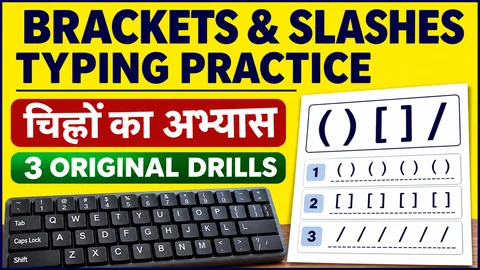
Parentheses, square brackets and slashes interrupt the usual letter-and-space pattern of a sentence. When copying a notice or a short office record, it is easy to type the words correctly and miss the closing symbol. These three original drills let you check each symbol in context. The fictional notices are practice material, not instructions from a real institution or official exam passages.
Set up a symbol copying task
Use English typing practice, choose My own paragraph and paste one drill paragraph into the setup box. Apply it with Use this paragraph, then type in the separate answer area. Leave out the heading and checking notes. These are continuous paragraphs, so you do not need to recreate columns or line breaks.
Before timing yourself, check which keys produce the symbols on your keyboard layout in a plain document. A physical key position or modifier that works on one layout may differ on another. The reference characters here are ordinary parentheses, square brackets and the forward slash. Do not substitute a backslash for a forward slash.
Drill 1: Parentheses inside a sentence
The reading room (first floor) opens after the morning assembly. Visitors may use the reference shelf (books remain inside the room) before the afternoon session. Please leave the completed worksheet (one copy per learner) on the front table.
There are three opening parentheses and three closing parentheses. Compare each pair around its own phrase. In the first sentence, the opening symbol follows a space after room; the closing symbol follows floor without a space inside the pair. The next word, opens, begins after a space. Preserve that pattern rather than adding spaces just inside the brackets.
After typing, read only the parenthesised phrases first. Then compare the full sentences to catch a word you may have skipped while concentrating on a symbol.
Drill 2: Square brackets in a record
Room [A] has spare chairs. Room [B] has the projector. The register shows [received] beside the paper delivery and [pending] beside the marker pens. The coordinator will review both entries before closing the record.
Here the square brackets enclose four separate items. A and B are capitals; received and pending are lowercase. Check the character immediately after each opening bracket and immediately before its closing partner. Do not replace the square brackets with parentheses even though the sentence would remain readable.
The labels describe a fictional record. They are not interactive controls on this page. Copy the supplied status rather than updating it to the status you think the item ought to have.
Drill 3: Slashes and mixed symbols
The form asks the volunteer to mark Yes/No beside each item. Please check the input/output label on the spare cable box. The final note reads [review needed] for Room [B] (projector cable). The assistant copied the note into the handover book before returning the box to the shelf.
There is no space on either side of the slash in Yes/No or input/output. Check the capital Y and N in the first pair. In the final note, square brackets and parentheses serve different parts of the reference; reproduce both instead of making them look uniform.
Try reading this mixed paragraph slowly before entering it. When a closing symbol appears near a full stop, check both characters and their order. In this reference, the full stop after projector cable follows the closing parenthesis.
Keep a specific review note
Write the reference phrase and your final copied phrase side by side. For example, [pending] and [pending differ by a missing closing square bracket. Yes/No and Yes / No differ by added spaces. These are examples of describing a mismatch, not official penalty calculations.
A short drill can finish before the selected duration expires when you reach the reference length. Record the finish reason rather than calling every short copy a complete five-minute test. For the site's result definitions, read how speed and accuracy are calculated. If your next task involves initials as well as punctuation, use the names and initials drills. For a longer record-style task, the numbers and office codes worksheet offers different material.
Put it into practice →