TYPING GUIDE
English Paragraph Ordering: 4 Exercises with Explained Answers
Arrange four original sets of English sentences, check the explained answers and use the corrected paragraphs for optional typing practice.
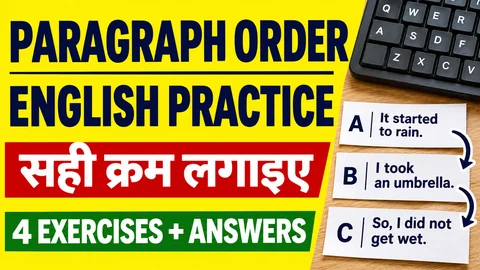
Before copying a paragraph, it helps to understand how its sentences fit together. This worksheet starts with a reading task: put four mixed sentences into a sensible sequence. Then use the corrected paragraph as a short copying reference. You will practise following events and references before concentrating on the keyboard.
All four exercises are original, with fictional everyday situations in a college, library or community office. They are not official examination questions or previous-year passages. The answer key explains the intended sequence, and the complete corrected paragraphs are provided so you can check your work without guessing.
How to use this worksheet
Read all four sentences in an exercise before choosing an opening. Write your answer as four letters on paper. Look for a sentence that introduces the person, object or problem; then follow the action through to its result. Words such as this, those and finally can help, but use the meaning of the whole paragraph too.
Do not put the letter labels or mixed sentences into a typing test. First finish the ordering activity and read the explanation. For optional typing practice, copy only the corrected paragraph below its answer. The ordering task is self-checked on this page; the typing tool does not mark your sequence of letters as a quiz answer.
Exercise 1: The revised notice
A. She removed the earlier notice and pinned the revised sheet in its place.
B. The office assistant noticed that the meeting room had changed.
C. Students reading the board later found the updated room number.
D. She prepared a new notice with the correct room number.
Which sentence identifies the problem? Which action requires the new sheet to exist already? Write the complete order before looking at the answer section.
Exercise 2: Returning a library book
A. Once the entry was complete, he placed the book on the returns trolley.
B. Meera handed a borrowed book to the librarian at the desk.
C. The next volunteer collected the trolley and took the book to its shelf.
D. The librarian found the borrowing record and marked the book as returned.
Find the first handover, then trace what happens to the book. The phrase once the entry was complete refers to an action in another sentence.
Exercise 3: A missing worksheet
A. After finding the original file, he printed the remaining copies.
B. Before the class began, the tutor counted the worksheets on the table.
C. Every learner then received a copy, and the activity started.
D. The count showed that several learners would be left without a sheet.
Decide what causes the printing task. Avoid treating then as an automatic opening: it points back to an event that should already be clear.
Exercise 4: Checking a damaged folder
A. The coordinator inspected the torn cover and chose a replacement folder.
B. The assistant moved the papers into that folder and labelled it.
C. While arranging the records, the assistant found a folder with a damaged cover.
D. The labelled replacement was returned to the correct position in the cupboard.
Find the discovery before the response. Ask which earlier sentence introduces the folder referred to by that folder.
Answer 1: B, D, A, C
B introduces the changed meeting room. D produces the new notice needed for A, where the earlier sheet is replaced. C gives the result for students who read the board afterwards. Moving A before D would require a revised sheet that has not yet been prepared in this sequence.
Corrected paragraph: The office assistant noticed that the meeting room had changed. She prepared a new notice with the correct room number. She removed the earlier notice and pinned the revised sheet in its place. Students reading the board later found the updated room number.
Answer 2: B, D, A, C
B introduces Meera and the returned book. D records the return, which explains the completed entry mentioned in A. The book reaches the trolley in A before the next volunteer collects it in C. Follow the object through the actions rather than arranging the sentences by length.
Corrected paragraph: Meera handed a borrowed book to the librarian at the desk. The librarian found the borrowing record and marked the book as returned. Once the entry was complete, he placed the book on the returns trolley. The next volunteer collected the trolley and took the book to its shelf.
Answer 3: B, D, A, C
B establishes the count before class. D reveals the shortage that makes more printing necessary. A resolves that shortage, and C describes distributing the copies and beginning the activity. The words remaining copies in A make more sense after the shortage is known.
Corrected paragraph: Before the class began, the tutor counted the worksheets on the table. The count showed that several learners would be left without a sheet. After finding the original file, he printed the remaining copies. Every learner then received a copy, and the activity started.
Answer 4: C, A, B, D
C introduces the damaged folder. A describes inspecting it and choosing a replacement. That folder in B refers to the replacement introduced in A. D closes the sequence by putting the labelled replacement away. The wording labelled replacement depends on the labelling action in B.
Corrected paragraph: While arranging the records, the assistant found a folder with a damaged cover. The coordinator inspected the torn cover and chose a replacement folder. The assistant moved the papers into that folder and labelled it. The labelled replacement was returned to the correct position in the cupboard.
Copy a corrected paragraph
Open the English typing practice tool, choose your own paragraph and paste one corrected paragraph into the setup box. Leave out the words Corrected paragraph and the answer heading. Apply the reference with Use this paragraph, then type the answer yourself in the separate area.
These are short references. The tool can finish when you reach the reference length, before the selected duration expires. Record the finish reason instead of calling that an entire five-minute test. Do not compare the four WPM results as though the paragraphs were calibrated to equal difficulty.
Check the exact copied wording after the attempt. Understanding the story is useful for reading, but replacing its words with a sensible paraphrase changes an exact-copy answer. In Answer 4, for example, papers and records are related words; that does not make them interchangeable in the reference.
Review the reading task separately
For each ordering answer you missed, write the clue you overlooked: a problem before its solution, an object before a later reference to it, or an action before its result. Keep that note separate from typing errors such as a missing letter or space. A correct sentence order and a clean typed copy are different observations.
For another original English activity, the mini mock with explained answers covers reading, grammar and vocabulary. For a more focused copying task, use the small-word worksheet. The speed and accuracy explanation describes the site's result measures; this ordering worksheet does not add a new examination scoring system.
Put it into practice →