TYPING GUIDE
Typing Error-Spotting Worksheet: 8 Exercises and Answer Key
Find missing words, repeated phrases, spacing and punctuation errors with eight original typing exercises, explained answers and correct-text practice steps.
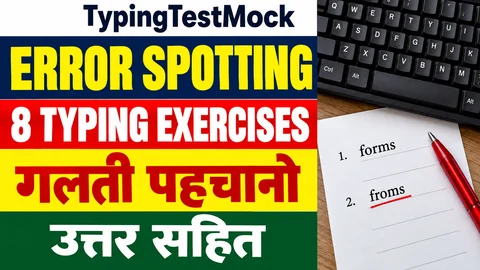
Find the difference before choosing a drill
A typing result becomes more useful when you can explain where your answer differs from the reference. This worksheet gives you eight original sentence pairs to compare, an answer key and a way to practise the correct versions in the typing tool. It is intended for English copying practice. The fictional library and classroom examples use familiar situations without including anyone's private records.
Each exercise contains a Reference sentence and a deliberately Mistyped copy. Find the difference before reading the answer key. Compare the text exactly, including capitals, spaces and punctuation. The task is not to rewrite a sentence into your preferred wording: a grammatical sentence can still differ from the supplied reference. These are original learning exercises, not official examination questions or previous-year papers.
Use the worksheet in two stages
First, compare the pairs without a timer. Write the exercise number and the fragment that needs changing in a notebook or a separate editor. If you print this guide using Print / Save PDF, cover the answer key until you finish. Record an observation such as missing word or missing space rather than giving yourself an invented examination penalty.
Second, open the English typing practice tool. Expand Choose practice type, select My own paragraph and paste only the correct Reference sentence into the setup field. Choose Use this paragraph, then type the sentence yourself in the answer field. Leave out the labels and the Mistyped copy. The answer field blocks pasted answers.
A single sentence is a short drill. The selected one-minute limit does not make it a full one-minute test: the attempt ends when you reach the reference length or the timer expires. It starts with your first input, and the result uses actual elapsed time. You can join the eight Reference sentences with spaces for a longer copying exercise, but still record an early finish accurately. Keep your keyboard and backspace setting steady when comparing attempts.
Exercise 1: an omitted word
Reference: The librarian placed six books on the return desk.
Mistyped copy: The librarian placed books on the return desk.
Read the whole sentence and identify the word that is absent. Check the words immediately before and after the gap. If you only look for unusual spelling, an omission may be easy to overlook because the remaining sentence still reads naturally.
Exercise 2: a repeated phrase
Reference: A volunteer checked the list before opening the gate.
Mistyped copy: A volunteer checked the list the list before opening the gate.
Find the extra phrase and note where it begins. Repetition can happen when you return your eyes to an earlier part of the reference. This worksheet does not diagnose why a particular learner repeated text; it gives you a clear difference to look for in a completed attempt.
Exercise 3: a substituted word
Reference: Please leave the green folder beside the window.
Mistyped copy: Please leave the blue folder beside the window.
Both versions are readable English sentences. Identify which word fails to match the reference. Accurate copying requires the original detail, even when a replacement word would make sense in another context. Read the full phrase rather than guessing its ending from the story.
Exercise 4: a changed word ending
Reference: The students returned their notebooks after the lesson.
Mistyped copy: The students return their notebooks after the lesson.
Compare the complete action word in both versions. A familiar beginning can make you move to the next word before copying the ending. Identify the missing letters, then practise the correct word inside the sentence rather than repeating only its first few characters.
Exercise 5: spacing after punctuation
Reference: Meera wrote a short note, then closed the register.
Mistyped copy: Meera wrote a short note,then closed the register.
The words and comma are present. Look at the boundary between the comma and the next word. Spaces belong to the copying task alongside visible letters. Review spacing explicitly if your result looks mostly correct but still shows differences around punctuation.
Exercise 6: capital letters within a sentence
Reference: The reading group meets in Pune on Friday.
Mistyped copy: The reading group meets in pune on friday.
Check both the place name and the day. The exercise asks you to preserve the letters shown in the reference. Practise the capitals using the input method you normally use, and record any change of keyboard when comparing this exercise with another attempt.
Exercise 7: a changed punctuation mark
Reference: Bring a notebook, a pen and a water bottle.
Mistyped copy: Bring a notebook. a pen and a water bottle.
Compare the mark after notebook. Do not rely only on the shape of the overall sentence or the space following the mark. A punctuation substitution can be small on the screen while still being a clear difference from the reference.
Exercise 8: letters entered in the wrong order
Reference: The assistant moved the forms to the right shelf.
Mistyped copy: The assistant moved the froms to the right shelf.
Read the letters of the troublesome word in order. Finding a familiar-looking beginning is not enough. After checking the answer key, practise the correct form slowly once, then put it back into the complete sentence so that you also rehearse the surrounding spaces.
Answer key with explanations
Exercise 1: the word six is missing between placed and books. The correct fragment is placed six books. Copying only placed books omits part of the reference, even though the sentence remains understandable.
Exercise 2: the phrase the list appears twice in the Mistyped copy. It should appear once after checked. The correct fragment is checked the list before. Remove the extra occurrence rather than changing a different part of the sentence.
Exercise 3: blue replaces green. The reference asks for the green folder. This is a word substitution, not a request to decide which colour is more appropriate for a real folder.
Exercise 4: return is missing the final ed found in returned. The correct fragment is students returned their notebooks. Complete the ending before moving to the space and the next word.
Exercise 5: there is no space after the comma in note,then. The correct fragment is note, then. Keep the comma and add the reference's space before then.
Exercise 6: Pune and Friday have been copied as pune and friday. Both initial letters need to match the capital letters in the reference. Treat these as two places to review rather than assuming that spotting one completes the exercise.
Exercise 7: the comma after notebook has become a full stop. The correct fragment is notebook, a pen. The remaining words and the final full stop should stay as shown in the Reference sentence.
Exercise 8: forms has become froms. The o and r are in the wrong order. The correct word is forms. Different scoring systems may represent a letter-order difference differently, so this worksheet does not assign it a universal numerical penalty.
Turn one observation into your next session
Choose one pattern from your answers and copy its correct Reference sentence in the tool. Review the final character comparison, then try an unfamiliar sentence containing the same kind of boundary or ending. Record the exercise, actual elapsed time, backspace setting and one next action. A memorised short drill and an unfamiliar sustained passage measure different tasks, so keep their speed results separate.
The final comparison shows differences in the submitted answer; it does not reconstruct every mistake you corrected while typing. Use how typing speed and accuracy are calculated to understand the site's measurements. For a longer routine, follow the seven-day accuracy plan. For digits and identifiers, use the numbers, dates and office-code drills. Your aim is to recognise a specific difference, practise the correct text and check whether the change carries over to new material.
Put it into practice →