TYPING GUIDE
Homophone Typing Practice: 5 Drills and an Original Passage
Practise copying their, there, two, too and other easily confused words with five sentence drills, checking notes and an original English passage.
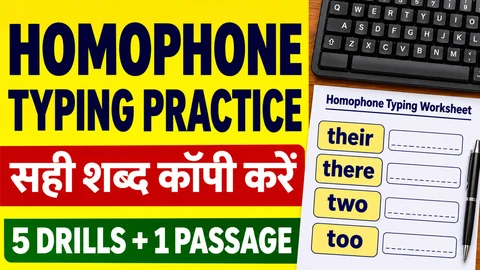
A word can sound right in your head and still be different from the word on the screen. Their and there are a familiar example. In an exact-copy typing exercise, your task is to preserve the written reference, including its spelling and apostrophes. You should not replace it with another word just because the sentence still sounds familiar.
This worksheet provides five short drills and one original passage. Each drill places easily confused words in complete sentences so that you can read the context before copying. The examples use fictional college, library and community activities. They are learning material, not official examination passages or a test of your spoken accent.
Prepare one drill at a time
Open the English typing practice tool, select your own paragraph and paste one drill into the setup box. Apply it with Use this paragraph. Include only the drill paragraph, without the heading or explanation. Type your answer in the separate area; answer paste is blocked.
Keep the correction setting consistent when comparing attempts. These short references may finish when you reach the reference length, before the selected duration expires. Record that finish reason rather than treating the result as evidence of a full five-minute session.
Before the first attempt, read the paragraph once and identify the words named in its heading. After the attempt, compare those words against the reference. This is copying practice, not a request to rewrite a sentence into a different style.
Drill 1: Their, there and they're
The students left their bags near the library desk. There was a clear space beside the shelves. They're waiting for the librarian to return before choosing their books.
Their connects something with the students: their bags and their books. There introduces the location-related statement in the second sentence. They're is the contracted form of they are. These explanations help you notice the written differences; the reference remains the final authority for what you type.
The paragraph contains two instances of their, one of There and one of They're. Check their positions as well as their totals. Typing the right number of each word in the wrong places does not reproduce the paragraph.
Drill 2: To, two and too
Two volunteers carried the chairs to the reading room. One table was too heavy for them to move safely, so they asked another volunteer to help.
Two is the number at the opening. To appears before the destination and before the verbs move and help. Too describes the table as excessively heavy for the two volunteers to move safely. Copy the complete word rather than deciding from its sound alone.
There are three standalone instances of to, one of Two and one of too. The checking count is a worksheet aid, not the site's scoring formula. If a count differs, find the sentence where the mismatch occurred instead of adding a spare word at the end.
Drill 3: Your and you're
Please keep your worksheet on the desk until you're ready to begin. If you're unsure about a word, compare it with your reference before continuing.
Your appears before worksheet and reference. You're means you are in both places where it appears. The apostrophe is part of you're, and there is no space inside the word. Expanding you're into you are might preserve the meaning, but it changes an exact-copy reference.
After typing, compare both apostrophes separately. Correcting the first occurrence does not prove that the second one is also correct. Check the comma in the second sentence while you are there.
Drill 4: Its and it's
The training centre changed its timetable after the room was repaired. It's using the larger room this week, and its notice board shows the new arrangement.
Its links the timetable and notice board to the centre. It's means it is in the second sentence. For this exercise, keep the apostrophe only where the reference shows it. Do not add one to its timetable because you associate possession with apostrophes in other constructions.
Read the full phrase when checking: its timetable, It's using and its notice board. A phrase gives you a more useful comparison unit than a quick glance at the first two letters.
Drill 5: Here and hear
Please wait here while I check the register. From this desk, you can hear the bell near the entrance. I will return here after speaking to the coordinator.
Here identifies the waiting place and the return location. Hear concerns the sound of the bell. The reference contains here twice and hear once. Notice the ending of each word before moving to the next space.
If you type the other spelling, record the reference and your final copy side by side. For example: reference says hear the bell; final copy says here the bell; word substituted. That is a description of a mismatch, not an official exam deduction.
Original passage: Preparing a reading session
Two volunteers arrived at the community library to prepare the reading room. They placed their folders on the front desk and checked the notice board. There was a short message about the session: please keep your worksheet ready before the discussion begins. One volunteer read the message again to confirm its wording. The notice also said, "It's a small group today, so the larger table will be enough." The other volunteer could hear someone arranging chairs near the entrance. "Please wait here while I bring another copy," he told a new participant. "You're welcome to use this pencil too." By the time the librarian returned, the volunteers had arranged the materials and checked that every participant had a clear place to sit.
This passage combines the word groups without turning them into a spelling quiz. Copy the punctuation and capitals exactly as printed too. A longer reference asks you to keep reading the context after each familiar word instead of entering its spelling from memory.
Review one substitution carefully
Compare one sentence at a time after the attempt. Mark the exact reference word, the version in your final copy and the point where the spelling changed. If you corrected a slip during the attempt, note that separately; the final submitted text is not a history of every wrong key you pressed.
Then copy the troublesome sentence once at a comfortable pace. Choose a different drill for the next timed attempt so you still have to read the reference. The drills and passage are not matched tests of equal difficulty, so their WPM differences are not precise measurements of improvement.
For the site's result definitions, read how speed and accuracy are calculated. If you are skipping connecting words rather than substituting similar-sounding ones, use the small-word worksheet. For more practice with apostrophes and speech punctuation, try the dialogue copying passages. Pick the next activity from an error you actually observed, and keep the focus on the written text in front of you.
Put it into practice →